By Nazreen Daud, Founder of Roquepress · Published 9 Nov 2026 · Last updated: 9 Nov 2026
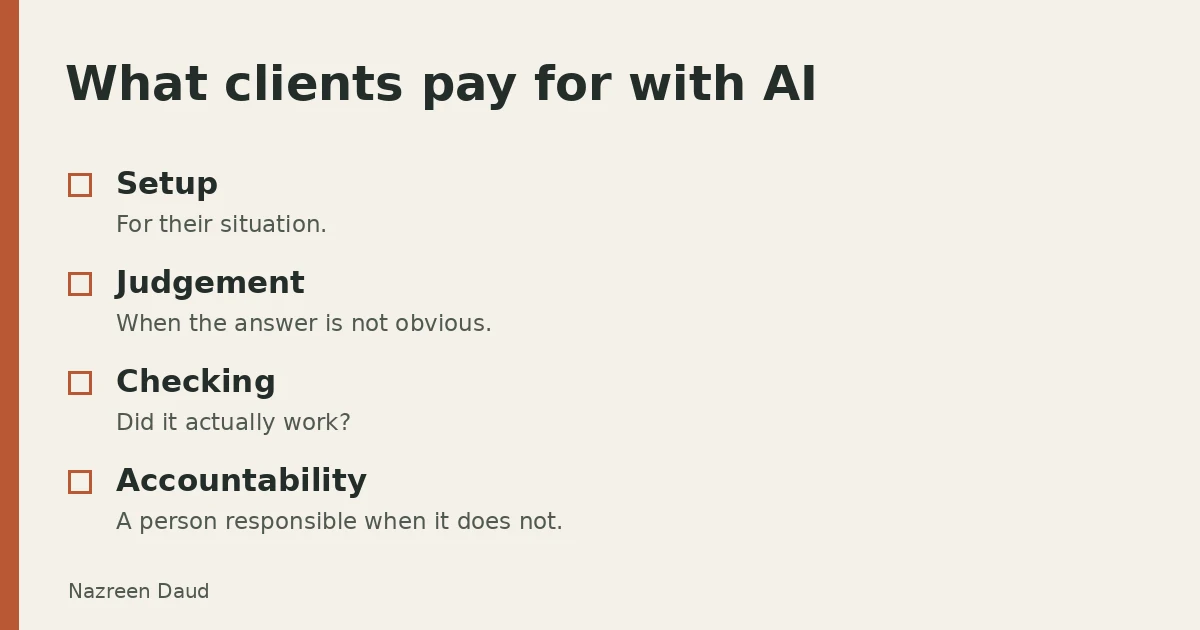
The short answer: what clients pay for with AI is rarely the draft button. They pay for setup that fits their situation, judgement when the answer is not obvious, someone checking that it worked, and a person accountable when it does not. Be open about what you automate and what you still check yourself.
In this article
- Why are clients asking what they're paying for?
- What is AI useful for in a service business?
- 1. Setting it up properly for their situation
- 2. Judgement when the answer isn't obvious
- 3. Someone checking that it actually worked
- 4. A real person who is accountable when it doesn't
- How do you explain a higher quote?
- Who is this not for?
- The four-point quote checklist
- FAQ
Why are clients asking what they're paying for?
Because AI has made the routine parts of many service jobs cheaper and more visible. When two firms quote for what looks like the same task, and one is clearly using AI to move faster, buyers start asking where the money goes.
I read in Troy Dean's Agency Mavericks newsletter that he switched accountants this month. A big firm and a small remote firm that uses AI quoted him for the same job, and the gap was wide enough for him to move. His point stuck with me: the client is the one paying for the boardroom.
That is his experience, told in his newsletter. I'm not repeating his numbers. The useful part is the question itself. It is coming to most service businesses, whether you use AI or not. I think that is good news for small firms who can say clearly what sits around the task.
If AI keeps handing every business the same generic plan, as I wrote in AI for business strategy, the difference buyers notice is the human work that shapes, checks and stands behind the output.
What is AI useful for in a service business?
AI is useful for the routine parts: first drafts, data entry, summaries, reminders, sorting a messy inbox. Cheaper routine work is good for your clients, and it frees up your time for the parts that still need you.
It is not a replacement for knowing their situation, choosing what matters, spotting when the answer is wrong, or being the person they call when something breaks.
Think of a kitchen with a good food processor. The chopping gets faster. Nobody tips the processor. They tip the cook who decided what to chop, tasted the result and took responsibility for the plate.
Singapore SMEs starting with AI do best when the first steps stay unglamorous and human-led, which is the thread in AI adoption for Singapore SMEs. The same rule applies to how you price and explain the work.
1. Setting it up properly for their situation
Setup is the work before the button. It is learning how their business actually runs, what "done" means for them, which tools they already use, and which risks they cannot take. Two clients can ask for "a monthly report" and need completely different setups.
A hypothetical example for a consultant
This is a made-up illustration, not a real client. A consultant uses AI to draft a competitor summary. The cheap version pastes public pages into a prompt and emails the result. The paid version first agrees which competitors matter, which claims need a source, and which internal numbers must never enter a public tool. The draft is faster because of AI. The quote is higher because of the setup.
Cherry Bekaert's note on generative AI risks in professional services (21 Aug 2025) puts the same idea in risk language: use AI as a support tool, validate outputs before client delivery, and communicate openly about how AI is used.
2. Judgement when the answer isn't obvious
Judgement is the part AI is bad at pretending to have. It can give you three options in ten seconds. It cannot tell you which option fits a client who is mid-rebrand, short on cash this quarter, or dealing with a staff change you heard about on the last call.
Illustrations across service businesses
These are labelled illustrations, not case studies.
- Coach: AI can draft a session agenda. Judgement decides whether this week needs the agenda, or a quieter check-in after a key hire left.
- Accountant: AI can sort transactions. Judgement decides when a pattern needs a conversation before the return goes in.
- Clinic / allied health: AI can draft a patient FAQ. Judgement decides which answers are safe to publish and which must stay with a qualified person.
- Consultant: AI can outline a proposal. Judgement keeps the sections the buyer can act on this month.
When the answer is obvious, automation is a gift. When it isn't, the person in the room is the product.
3. Someone checking that it actually worked
Checking is the unglamorous middle. Did the draft match the brief? Did the numbers add up? Did the email go to the right list? Did the booking actually land in the calendar? A green tick on a tool is not proof the outcome happened.
Accounting Today's coverage of AI governance in firms (Chris Gaetano, 4 May 2026) keeps returning to one idea: the human is in control. Firms that take this seriously treat human validation as part of the workflow, not an optional extra.
A hypothetical example for a coach
Another made-up illustration. A coach uses AI to send a post-session summary. Checking means confirming the action points match what was agreed on the call. Without that step, a confident summary can invent homework the client never accepted. The AI made the writing cheap. The check keeps the relationship intact.
The same habit applies to your marketing. If you care how much traffic an AI answer engine sends, you measure it, which is the point of how much traffic ChatGPT sends compared with Google.
If you'd like a second pair of eyes on how you explain AI and human checks in your sales conversations, book a call with me.
4. A real person who is accountable when it doesn't
Accountability is the line clients feel even when they cannot name it. When something is wrong, who do they email? Who fixes it? Who does not blame the tool?
In the same Accounting Today piece, one firm principle is blunt: the team is not permitted to blame automation for an error, and that extends to AI. The buck stops with the human who directed the work. That is why a higher quote can still be the safer buy.
What accountability looks like in practice
- A named person on the quote and the kickoff email.
- A clear "if this is wrong, here is what we do next" line in the scope.
- A reply window you can keep on a busy week, written down before you promise it.
- No hiding behind "the model said so" when a client is owed a correction.
This is also where your sales call habits matter. The questions you ask before you quote show whether you expect to be accountable for a real outcome, not just a file. I wrote about putting those sales call questions on your website so buyers see the standard before the call.
How do you explain a higher quote?
Say what you automate and what you still check yourself.
A simple structure:
- Routine parts: "We use AI for first drafts / sorting / summaries."
- Human parts: "We still set this up for your situation, decide the non-obvious calls, check the output, and stay accountable if it misses."
- What the cheaper quote often leaves out: name the missing setup, check or named owner without attacking the other firm.
Three short lines in a proposal or a follow-up email are enough. When the routine work gets cheaper, the person responsible for getting it right is what's worth paying for.
Who is this not for?
If your offer is a pure product with no custom setup and no ongoing accountability, this framing will feel heavy. Price the product, say what the button does, and keep the page short.
It also fits less well if you do not use AI at all. You can still talk about judgement, checking and accountability; just drop the automation line.
And if a buyer only wants the cheapest draft with no review, they are not buying the four points in this article. That can be a clean no.
The four-point quote checklist
Before you send the next quote that might sit next to an AI-heavy competitor, tick these off.
- I can name which parts of this job I use AI for.
- I can name the setup that is specific to this client's situation.
- I can point to at least one judgement call that is not obvious from a prompt.
- I have a checking step before anything client-facing goes out.
- The quote names a person who is accountable if something is wrong.
- I can explain the higher price in three short lines without attacking another firm.
- I have not promised a reply window or fix path I cannot keep on a busy week.
If you'd like me to pressure-test that explanation on a real quote of yours, book a call with me.
FAQ
What do clients pay for when a firm uses AI?
They pay for the work around the task: setup that fits their situation, judgement when the answer is not obvious, someone checking that the output worked, and a person who is accountable when it does not. AI can make the routine parts cheaper. The quote still has to cover the human parts that protect the result.
How do I explain why my quote is higher than an AI firm?
Be specific. Say which parts you automate, which parts you still set up and check yourself, and who is accountable if something misses. Three short lines in a proposal usually beat a long defence. Avoid attacking the other firm; show where the money goes in your own process.
Should service businesses tell clients they use AI?
Yes, in plain language. Clients are already comparing quotes. Saying what you automate and what a person still reviews builds trust and sets expectations. Professional-services guidance on AI risk keeps returning to human review and open communication for the same reason.
Does using AI mean I should lower my prices?
Not automatically. If AI removes routine hours, you can pass some of that on, keep some as margin, or reinvest the time in better setup and checking. The price should still reflect the judgement and accountability the client is buying.
So, if a client asked why your quote is higher than the firm using AI, what would you say?
About the author: Nazreen Daud is Founder of Roquepress and a Malay web consultant and marketer in Singapore. He has built websites for businesses since he started freelancing in 2013, registered Roquepress in 2019 and founded Mulacan in 2022. He writes practical, hype-free notes on websites, SEO and AI for service businesses.