By Nazreen Daud, Malay web consultant and marketer in Singapore · Originally shared on LinkedIn, 14 October 2026
The short answer: Singapore SMEs are using more AI every year, but larger firms are pulling further ahead. IMDA's latest figures put AI adoption at 23.4% for SMEs versus 70.4% for larger firms. If you run a small service business, skip the big AI programme and start with three steps: one messy handoff, one list of facts, one tool you already pay for.
How many Singapore SMEs use AI?
Singapore SMEs are using more AI every year. Larger firms are still leaving them in the dust.
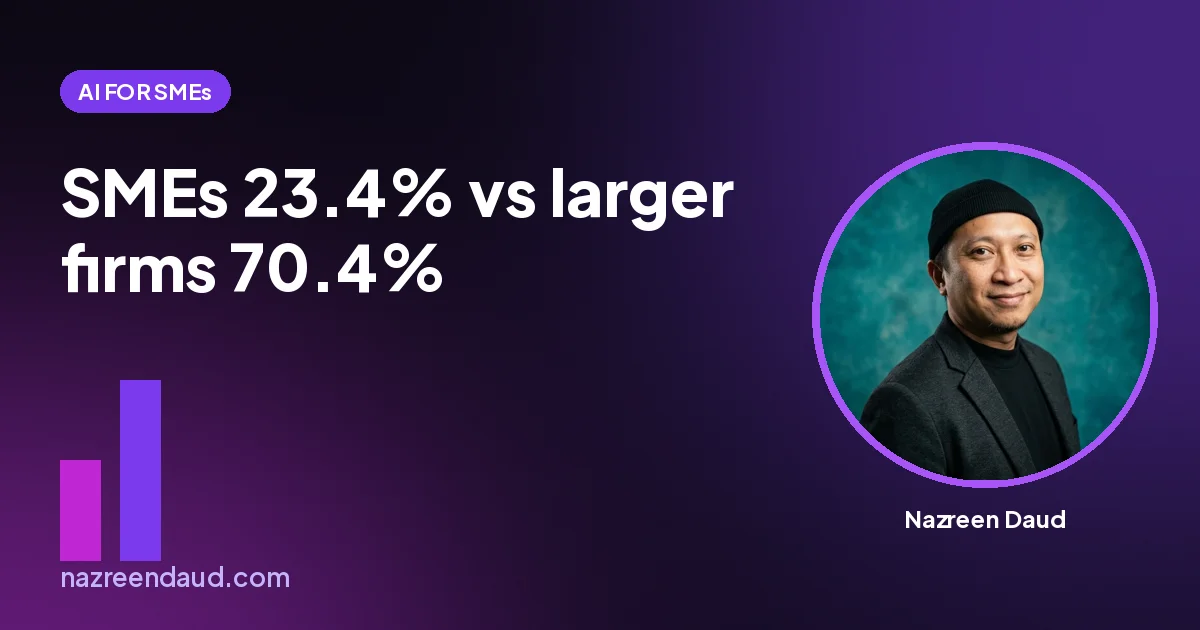
IMDA's Singapore Digital Economy Report 2026 (covering 2025), released on 5 October 2026, put AI adoption at 23.4% for SMEs and 70.4% for larger firms. A year earlier, IMDA's figures were 14.5% versus 62.5%.
| Year (data) | SMEs using AI | Larger firms using AI | Gap |
|---|---|---|---|
| 2024 | 14.5% | 62.5% | 48.0 points |
| 2025 | 23.4% | 70.4% | 47.0 points |
Source: IMDA, Singapore Digital Economy Report 2026 (published 5 Oct 2026), also reported by CNA and The Straits Times.
SMEs moved. The gap did not close.
Why are SMEs behind on AI?
It isn't a lack of ambition. ASME president Ang Yuit put it plainly in The Straits Times' coverage: AI use among SMEs is still very uneven, and time, budget and manpower to plan the work are the real blockers.
That matches what you'd expect in a small team. When five people are serving clients, answering enquiries and chasing invoices, nobody has a free month to design an "AI transformation". So it doesn't happen, or it happens in random bits.
What should a small service business do first?
If you run a five-person Singapore service business, skip the big AI programme. Start with three unglamorous steps this month.
Step 1: Pick one messy handoff and write down the steps
Choose one place where work regularly gets stuck or dropped:
- enquiry to reply,
- quote to follow-up, or
- "who owns this lead?"
Write down the steps you already take, in plain language. You can't improve, automate or hand to AI something nobody has written down.
Step 2: List the facts you must never get wrong
Put them in one short list: prices, what's included, your response time and who replies. Keep that list next to whoever drafts messages with AI.
AI tools are confident even when they're wrong. A one-page fact list is the cheapest protection you can have against an AI-drafted reply quoting the wrong price or promising something you don't offer.
Step 3: Turn on one thing in a tool you already pay for
Choose one tool you already pay for. Turn on one reminder or one template that saves a real hour a week. Then stop and check it worked.
Many tools small businesses already use have AI or automation features that are switched off or unused. Starting there costs nothing extra and teaches your team more than a new subscription would.
| Step | Effort | What you'll have at the end |
|---|---|---|
| 1. Map one handoff | Small | A written process you can improve |
| 2. Write your fact list | Small | A safety net for AI-drafted messages |
| 3. Switch on one feature | Small | One real hour saved each week, checked |
Not sure which handoff to start with? Book a call with me and we'll pick the one that's costing you the most.
What does "winning" with AI look like for an SME?
The win is not "we use AI". The win is fewer missed enquiries and clearer next steps for clients.
That's the lens I use as a Malay web consultant and marketer in Singapore, whether I'm working on a website at Roquepress or on follow-up systems in Mulacan. If a tool doesn't help a client get a faster, clearer answer, it's a toy, not a system.
Which of those three would help your team most this month: 1, 2 or 3?
FAQ
What percentage of Singapore SMEs use AI? According to IMDA's Singapore Digital Economy Report 2026, as reported by CNA and The Straits Times, AI adoption among SMEs was 23.4% for 2025, up from 14.5% a year earlier. Larger firms were at 70.4%, up from 62.5%.
What stops small businesses in Singapore from adopting AI? ASME's Ang Yuit has said AI use among SMEs is still very uneven, with time, budget and manpower to plan the work being the real blockers. Small teams are busy serving clients and rarely have spare capacity for large AI projects.
What is the easiest first AI step for a small service business? Pick one messy handoff, such as enquiry to reply, and write down the steps you already take. Then create a short list of facts you must never get wrong and switch on one reminder or template in a tool you already pay for.
Do I need a big AI budget to start? No. Start with tools you already pay for and one clearly defined process. Measure whether it saves a real hour a week before adding anything new. Small, checked wins build more capability than a large programme nobody has time to run.
Next step
If you'd like help choosing and setting up your first practical AI step, book a call with me. Read more about me, see the tools I use, or explore my ventures.