By Nazreen Daud, Founder of Roquepress · Published 3 Nov 2026 · Updated 3 Nov 2026
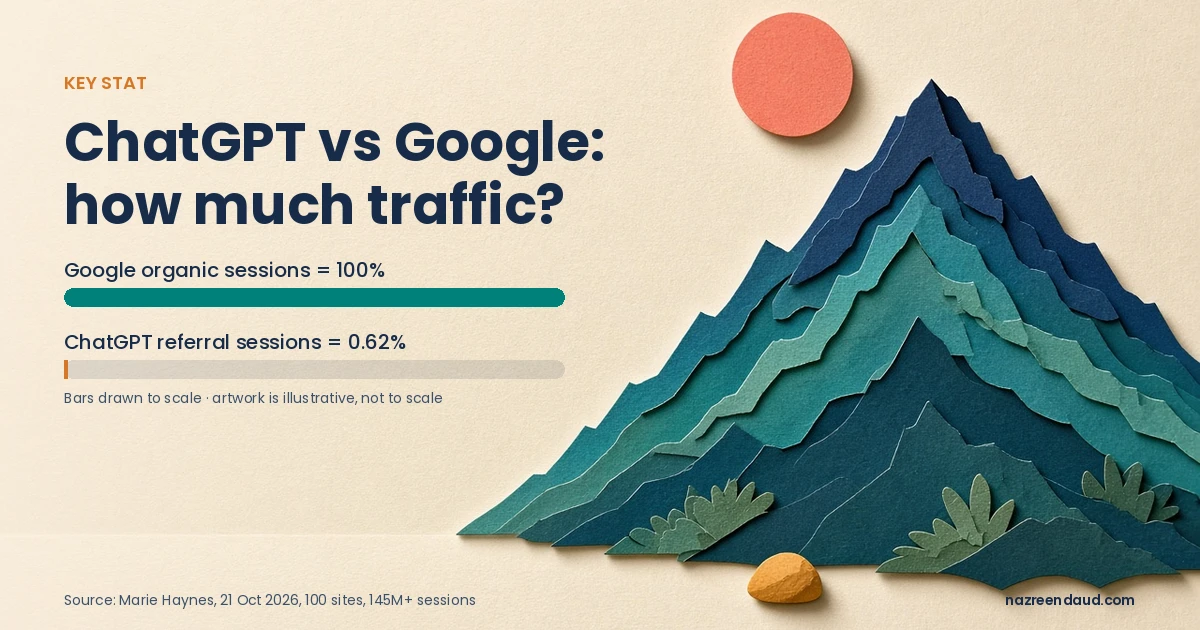
The short answer: how much traffic does ChatGPT send? Very little, next to Google. Across 100 sites studied by Marie Haynes, ChatGPT sessions were 0.62% of Google organic. On the 55 that tracked conversions, Google drove 96.5% of them. So I'd keep Google organic as the main measure, and treat AI visibility as brand-building, tracked through branded searches.
What have I seen with my own clients?
One of my long-serving SEO clients mentioned that, through our work, ChatGPT referrals are now pointing to their business. I'm super proud that it happened.
As nice as that is, Google is still where their traffic comes from. To me, the two work hand in hand.
That's one client, not a study, so I won't read too much into it. The October 2026 numbers below point the same way, from far more sites.
What did the October 2026 studies find?
Three separate looks at real analytics data came out in October 2026. AI assistants send a small slice of the visits Google sends. Here they are, with sample sizes.
Marie Haynes: 100 sites, 12 months of GA4
Marie Haynes looked at 12 months of Google Analytics 4 data across 100 websites of varying sizes, with over 145 million sessions. In her October 2026 analysis, ChatGPT sessions were 0.62% of the volume driven by Google organic. With all the other AI tools included, it rose to 0.73%.
Conversions tell a similar story. Only 55 of the 100 sites tracked conversions, and she calls it her "small dataset". On those, ChatGPT visitors converted at 13.8% against 3.02% for Google organic. Yet Google drove 96.5% of total conversions across the channels analysed, about 27 times more than all the AI tools combined.
She also found that ChatGPT referral growth stopped around August 2025, when GPT-5 was released, and has declined since.
The SEO Works: 95 sites, organic sent 39 times more
The SEO Works published an October 2026 benchmark of AI referral traffic covering 95 GA4 properties from September 2025 to August 2026. Organic search delivered 39 times more traffic than AI assistants: 2,825,594 organic sessions against 72,095 AI referral sessions.
| What was measured | Organic search | AI assistants |
|---|---|---|
| Sessions (95 sites, 12 months) | 2,825,594 | 72,095 |
| Conversions, per 100 from organic (63 sites) | 100 | 3.2 |
| Conversion rate (pooled) | 6.08% | 7.18% |
Of the three, this is the one I trust most on method. It states its thresholds and limits, and you can download the data.
Kevin Indig: the "hidden AI traffic" in Direct
A common reply is that AI traffic hides in "Direct" (visits with no known source). Kevin Indig went looking in his 12-site sample, which skews B2B. Much of the Direct growth he found was bots. One site logged 409,000 Direct sessions, and only 198 of them were engaged. Engaged Direct traffic has been flat since January.
He also tested whether more AI visibility was followed by more branded searches or Direct visits, across four brands and 632 tests. He couldn't establish a reliable link.
Do ChatGPT visitors convert better than Google visitors?
Often, yes, but on tiny numbers. In both data studies, AI visitors converted at a higher rate than organic visitors. Because there are so few of them, the total business they bring in stays small, and that's the number a business owner actually banks.
The SEO Works put it neatly. AI traffic converted a fifth better than organic (7.18% against 6.08%), but worse on 23 of 63 sites, and worse for B2B product businesses (0.62 times the organic rate). Then the line I'd pin above every marketing budget: on their numbers, a 5% lift in organic would bring in more extra conversions than doubling AI referral traffic.
Think of it like a stall at a pasar malam (a Singapore night market). One stall gets a steady crowd walking past all evening. The other gets a few people who came looking for it on purpose. The second stall's visitors buy more often. The first stall still pays the rent.
Is AI a brand channel, not a traffic channel?
This is the best counter-argument, and it deserves a fair hearing. Mike King of iPullRank argues that every one of these studies "grades a brand channel with a traffic ruler". He agrees AI search "sends very little traffic, and it probably always will", but says it should be budgeted like brand, not judged on clicks.
You can read his argument in full. A billboard on the PIE (the Pan-Island Expressway) doesn't get clicks either, and nobody calls it worthless for that.
Rand Fishkin of SparkToro, mostly sceptical, summarised the studies as showing AI-assistant traffic is "nearly non-existent", but endorsed King's view that AI is "more like a brand channel, a digital billboard".
My view sits close to King's. I'm not ignoring AI. I'm refusing to grade it on clicks.
How should you measure AI visibility?
I'd keep two separate lines. Google organic is the headline number in the report. AI sits in its own small section, measured as brand, with no pretence that it's a traffic source.
For the brand side, here's what I'd look at:
- Is the business named correctly? Ask the main AI assistants about the business and check the name, offer and location are right.
- Are branded searches rising? In Google Search Console (Google's free tool that shows what people searched to find you), watch searches that include the business name.
- What do new enquiries say? A simple "How did you hear about us?" question on the enquiry form catches what analytics misses.
One caveat matters here. None of these studies showed that AI visibility leads to more branded searches later. Indig tested it on four brands and couldn't find a reliable link, and The SEO Works found no evidence that AI growth drives Direct visits. So branded-search tracking is the best signal I have, not proof.
My hypothesis, and it's only a hypothesis, is that SEO and AI search work hand in hand. The SEO Works found that the sites gaining AI referral traffic were the ones whose organic performance was improving. That fits, but it's a correlation, not proof. So I wouldn't focus only on AI search. Get the SEO foundation right first: a clear offer, facts that match across the web, and pages that say plainly what you do. Then the rest of the "EO" alphabet (GEO, AEO and friends) has something to work with.
If you'd like a second pair of eyes on what your reports should track, book a call with me.
What should a small business owner do this quarter?
Keep Google as your main measure, report AI separately, and spend on the basics before any AI-tracking tool. Here's the checklist I'd hand a busy founder.
AI traffic checklist for this quarter
- Keep Google organic as the main traffic number in your reports.
- Report AI referrals (chatgpt.com, perplexity.ai and similar) as a separate line, so they don't get lost or oversold.
- Check branded searches in Google Search Console once a month.
- Add a "How did you hear about us?" field to your enquiry form.
- Ask two or three AI assistants about your business, and note anything wrong.
- Fix the basics first: a clear offer and consistent facts across your site and profiles.
- Hold off on paid AI-tracking tools until the above is done.
If you want the "how to get seen" side, my guide to AI search visibility for small businesses covers it. And if you're thinking of adding a chatbot to your site, read why I'd feed your website's AI assistant less first.
What don't these studies prove?
They don't prove AI is worthless, and they don't prove it's secretly huge. The samples are small, the data is mostly private, and analytics tools miss some AI visits. Treat the numbers as a strong hint about the size of the gap, not the final word.
A few honest caveats:
- Small samples. 100, 95 and 12 sites. The authors are a consultant, an agency and a newsletter writer. Only The SEO Works shares its data.
- Analytics undercount AI. Some AI visits arrive with no referrer, and some people read an answer and then Google the brand. Clicks from Google's own AI Overviews (and usually AI Mode) show up as Google organic, so the "Google" bucket already includes some AI search.
- Correlation isn't cause. AI and organic growth moved together, but that doesn't show which drives which.
- Conversions aren't revenue. They're actions tracked in GA4, such as form sends, not people or sales.
- It may change. The SEO Works saw AI's share rise from May 2026: from 2.29% of organic sessions (September 2025 to April 2026) to 3.04% (May 2026 onwards).
None of that flips the conclusion for a small business today: Google still sends the visits, and AI is worth getting right, not grading on clicks.
For more on this, see my AI search and SEO articles.
FAQ
How much traffic does ChatGPT send compared with Google?
Very little. In an October 2026 study of 100 websites, Marie Haynes found ChatGPT sessions were 0.62% of Google organic. A separate benchmark by The SEO Works, covering 95 sites, found organic search sent 39 times more traffic than all AI assistants combined. Your own numbers may differ, so check your analytics.
Do visitors from ChatGPT convert better than Google visitors?
Often, yes. In Marie Haynes's data, ChatGPT visitors converted at 13.8% against 3.02% for Google organic, on the 55 sites that tracked conversions. But Google still drove 96.5% of conversions. The SEO Works found AI converted a fifth better overall, yet worse on 23 of 63 sites.
Is GEO (optimising for AI answers) a waste of time?
Not if you treat it as brand, not traffic. The basics that help AI tools describe you correctly, like a clear offer and consistent facts, also help Google. What I'd avoid is paying for AI work on the promise of lots of clicks. The October 2026 data doesn't support that promise.
How can I tell whether AI assistants are mentioning my business?
Ask the main AI assistants about your business and check the details are right. Watch branded searches in Google Search Console, and ask new enquiries how they heard about you. None of these prove AI sent the enquiry, but together they're the best signal most small businesses have.
So, has ChatGPT ever sent you a client you could actually trace?
About the author: Nazreen Daud is Founder of Roquepress and a Malay web consultant and marketer in Singapore. He has built websites for businesses since he started freelancing in 2013, registered Roquepress in 2019 and founded Mulacan in 2022. He writes practical, hype-free notes on websites, SEO and AI for service businesses.