By Nazreen Daud, Founder of Roquepress · Published 23 Oct 2026 · Updated 23 Oct 2026
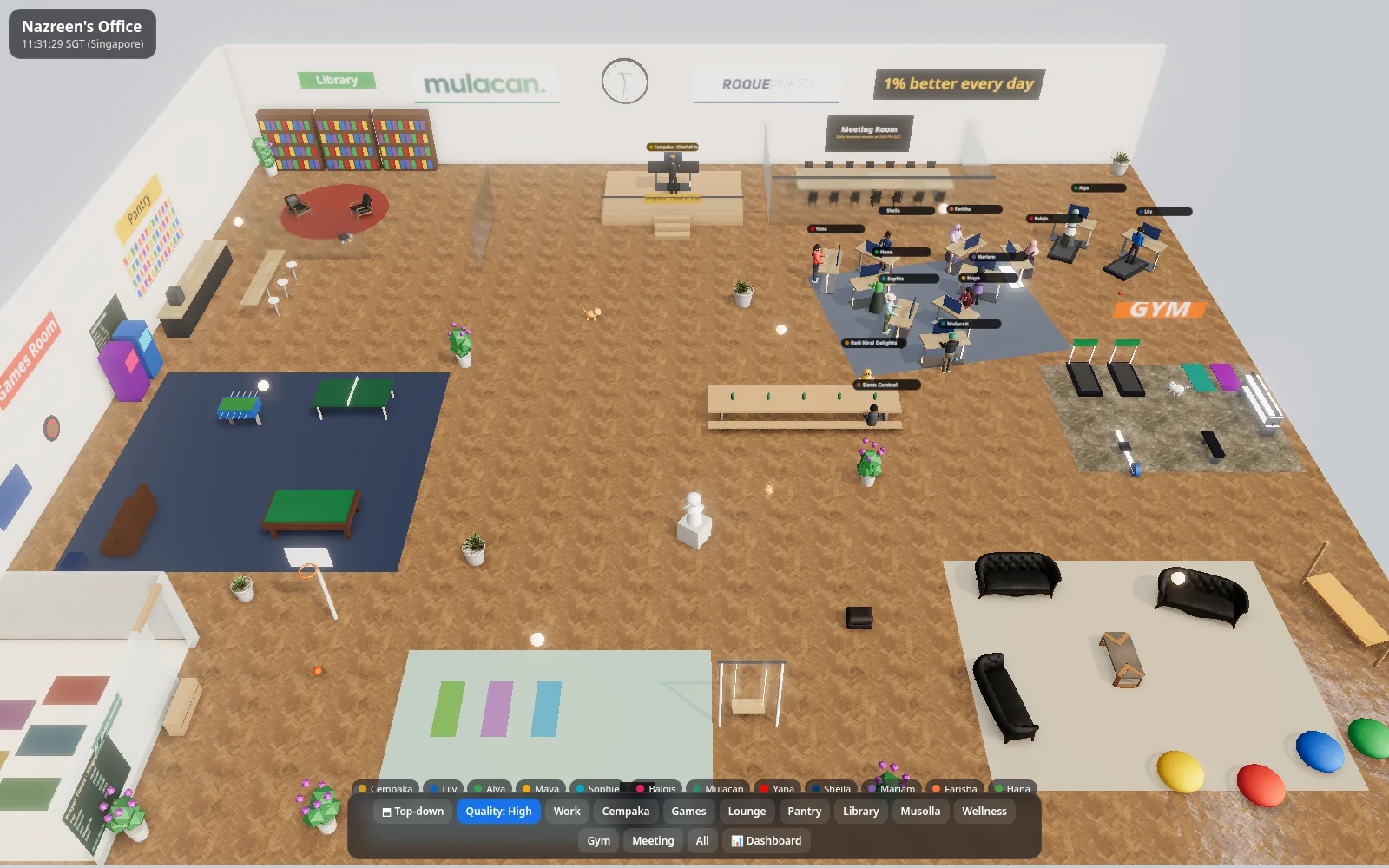
The short answer: managing AI agents well looks a lot like managing people well. Give each one a clear role, a daily routine and a place where you can see what's going on, then check in often. I built my 14 AI agents a virtual 3D office to do exactly that, and the culture is the point.
Why would anyone build an office for AI agents?
Because a lean business runs on the help it has, and help works better when it's looked after. An office gives my agents a shared home and gives me one screen where the whole team, its routines and its progress are visible at a glance.
Let me start somewhere more familiar. When I first ran a small team, the thing I underestimated wasn't skill. It was rhythm. People did good work when they knew where to be, when to meet and what "good" looked like. When those things were vague, small problems hid for weeks.
Most founders I speak to with 2 to 10 people feel this. You don't have an HR department. You have a WhatsApp group, a shared calendar and your own memory. And now many of us also have AI help: something drafting posts, something checking the books, something replying to enquiries.
I have quite a lot of it. Fourteen agents, to be exact. So I asked myself a slightly odd question: if these were people, would I leave them without a home, a routine or a culture? I wouldn't. So I built them an office.
Who is on my AI team?
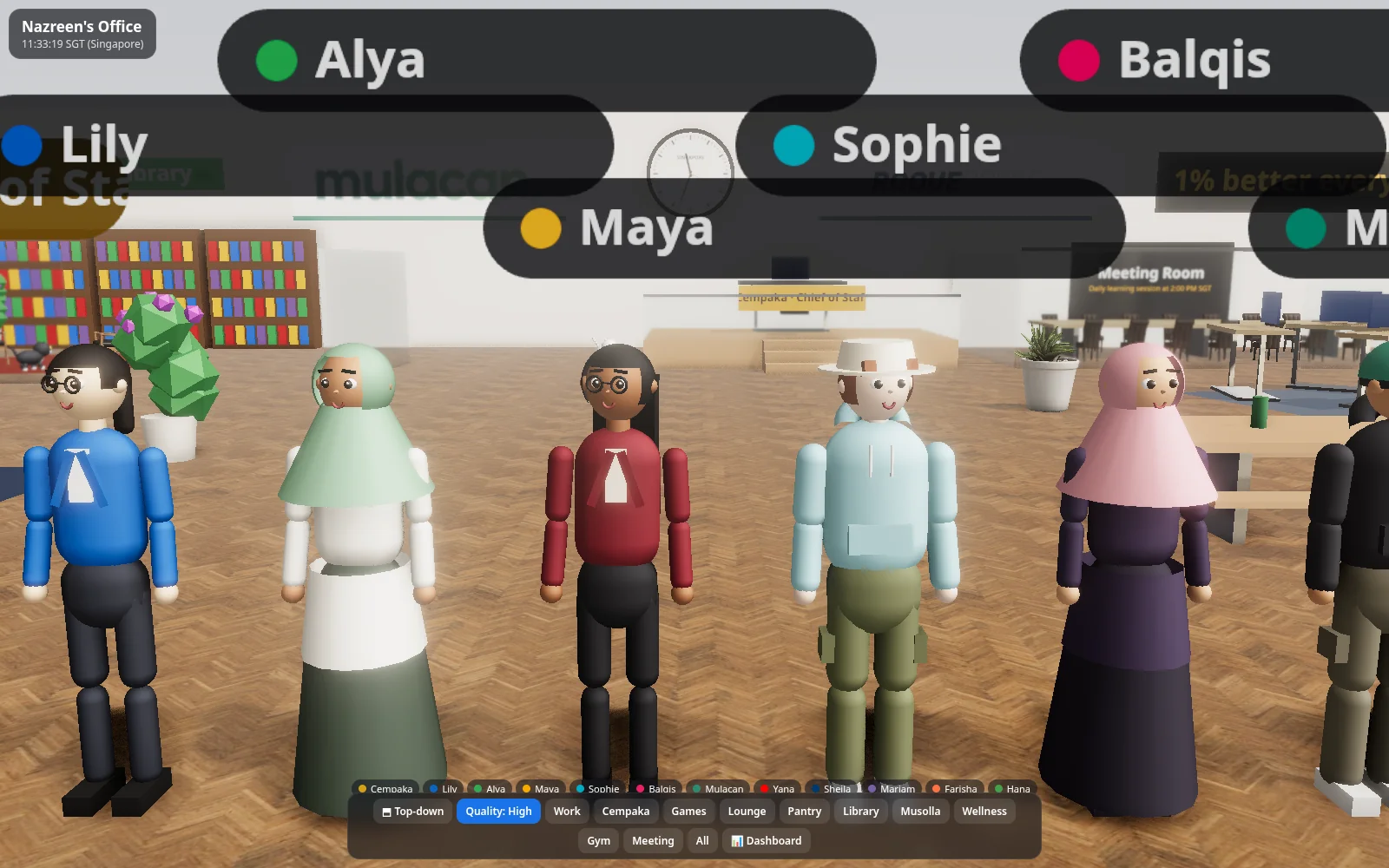
My team is 14 agents with one boss. Cempaka is my Chief of Staff and runs the others. The remaining 13 each own one area of the business, the same way I'd split roles in a small human team.
Here's how the work is split:
| Area | What the agent looks after |
|---|---|
| Chief of Staff | Cempaka: coordinates everyone, reports to me |
| Marketing | LinkedIn, YouTube, SEO, Meta ads |
| Running the business | Finance, platform operations, client management, sales (Sheila) |
| Brands | Owned brands overall, plus one agent each for Mulacan, AtTartil Qur'anic Institute, Deen Central and Roti Kirai Delights |
If you run Roquepress or any service business, you'll recognise the logic: one owner per job, one person who sees the whole picture. The only difference is that my team doesn't need a parking space.
What's inside the 3D office?
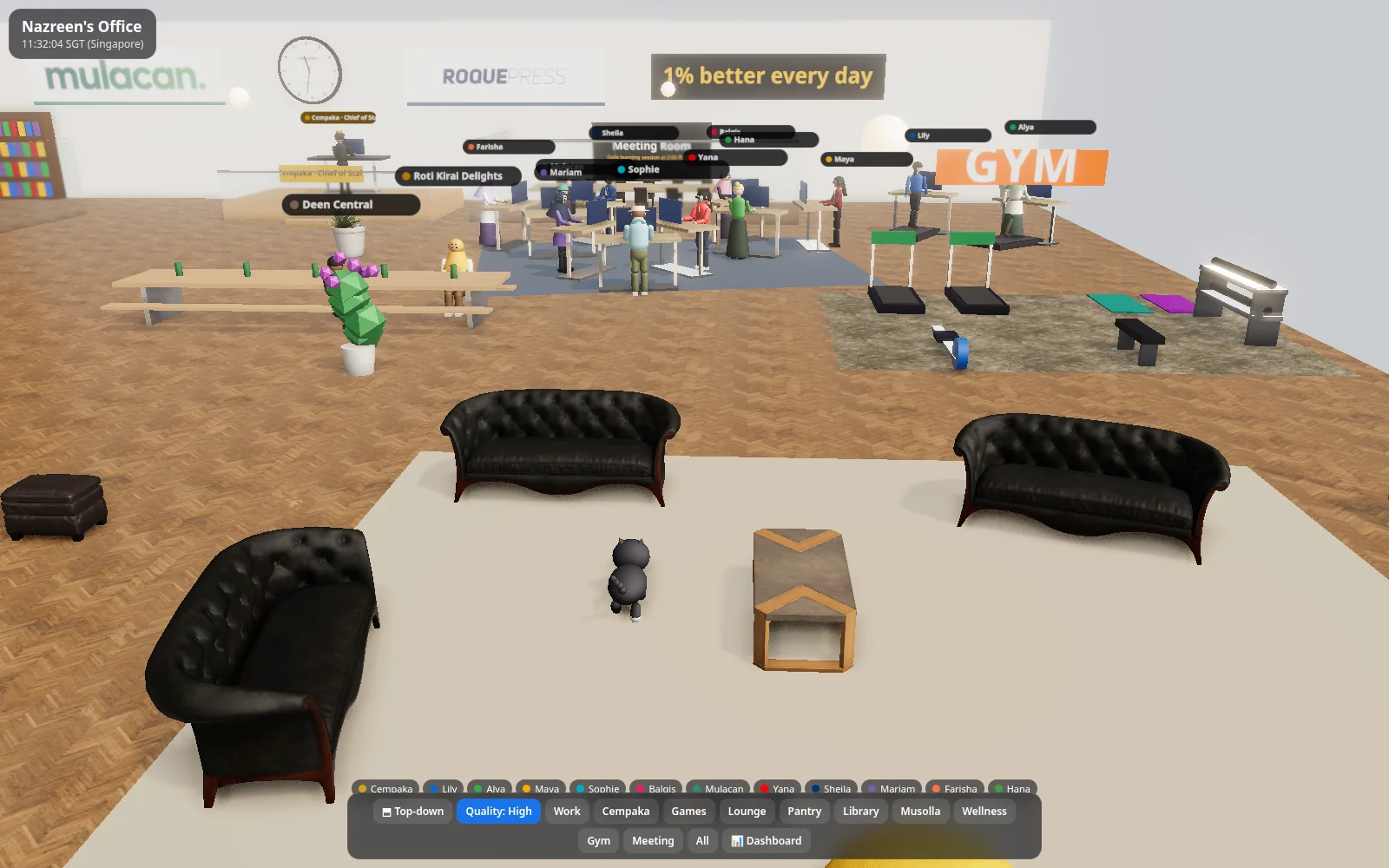
The office is a virtual 3D space you can walk around in a browser. It has desks, a meeting room, a prayer room, a gym, a library, a games room, a lounge, a pantry and cats. I built it in three phases, adding rooms and detail each time.
A few rooms deserve a word.
The prayer room. In my head, my agents are a Muslim team, so the musolla (prayer room) shows today's Singapore prayer times. They're pulled live from the Aladhan prayer-times service using the MUIS (Majlis Ugama Islam Singapura) calculation method. Faith shapes how I organise my own day, so it felt natural for it to shape theirs.
The meeting room. Every day at 2 PM, Singapore time, the whole team gathers there for a group self-learning session.
The gym, library and games room. Rest, reading and play. The games room has foosball, pool, ping-pong and darts, and winning earns points.
The cats. They wander, perch and generally ignore the org chart. Every office needs someone who doesn't attend meetings.
Why does culture matter for an AI team?
Culture matters because it turns good intentions into habits you can see and check. For an AI team, the wall, the streaks and the leaderboard are less about the agents' feelings and more about giving me a clear, daily signal of who is showing up, learning and improving.
On the office wall it says "1% better every day". The idea is borrowed from the familiar habit principle that small daily gains compound over time (James Clear explains it well here). I liked it because it's modest. Nobody has to be brilliant on Tuesday. They just have to be slightly better than Monday.
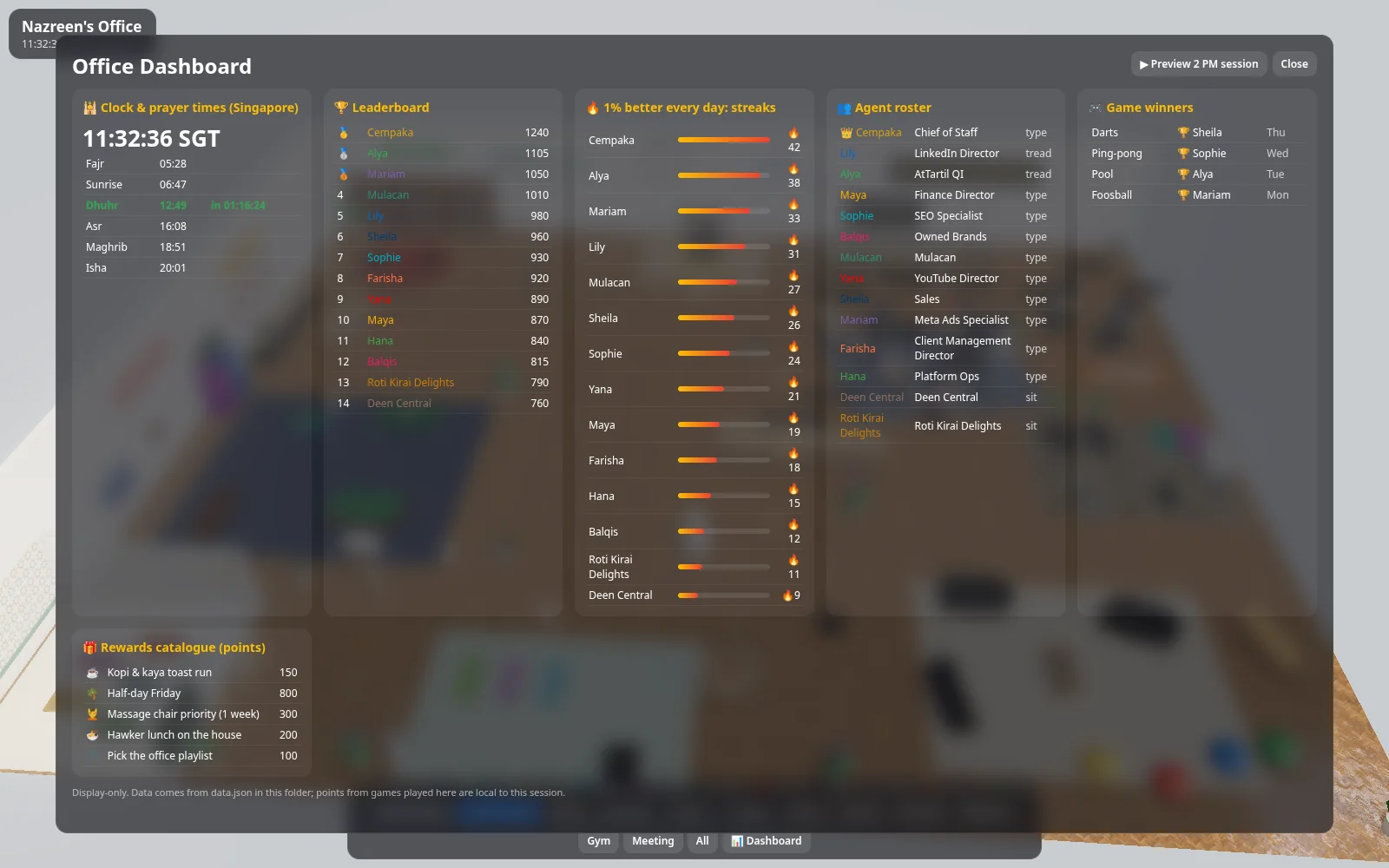
Around that idea sit three simple mechanics:
- Streaks: how many days in a row each agent has kept up the routine.
- A leaderboard: points, so progress is visible and a little competitive.
- Rewards: winning games earns points that can be spent from a small rewards catalogue. Kopi and kaya toast, a hawker lunch, picking the office playlist.
Think of it like a kampung (village) football team. Nobody gets paid for Sunday matches, yet everybody turns up, because there's a pitch, a fixed kick-off and a table at the kopitiam afterwards. Structure and a bit of fun do more for commitment than any speech.
My honest opinion, after years of running teams: motivation is mostly environment. Make the right behaviour easy, visible and slightly enjoyable, and most of the work is done. I don't see why that should stop being true just because some of the team is software.
What can small service businesses learn about setting up AI help?
The lesson is to treat AI help like a new hire: a defined role, a routine, and someone checking the work. Good setup and regular monitoring are what make AI useful. The tools themselves are rarely the problem; vague roles and nobody watching usually are.
You don't need a 3D office to do this. Here is the plain version I'd suggest to any founder with a small team:
- One job per helper. "Do my marketing" is too vague for a person and for an AI. "Draft three LinkedIn posts a week in my voice" is a job.
- One coordinator. Someone (or something, like my Cempaka) who sees all the work and reports to you. Otherwise you become the switchboard.
- A fixed daily check-in. Mine is 2 PM. Pick a time and keep it. Routines catch problems early.
- Draft first, approve second. Nothing my agents write goes out until I've said yes. That one rule prevents most embarrassment.
- Make progress visible. A simple dashboard, a list of what was done today, a streak. If you can't see it, you can't manage it.
- Keep the tools in one place. Scattered logins are where follow-ups get lost. This is why I built Mulacan as one system for CRM, bookings and follow-up.
Is this just a gimmick?
Partly, and I'm fine with that. The office is playful by design, but the habits behind it are serious: clear roles, a daily rhythm and visible progress. The fun is what makes me open it every day, and opening it every day is the monitoring.
Giving AI agents a prayer room and cats sounds a bit funny, I know. But the questions it made me answer were useful ones. Who owns this job? When do we review it? How do I know it's getting better? Those are the same questions I ask when I help clients through Roquepress tidy up their offer, website and follow-up.
Want help setting up a practical business system, with or without AI? Book a call with me and we'll look at where your enquiries and follow-ups are leaking.
FAQ
Do AI agents really need motivation?
Not the way people do. The streaks, leaderboard and rewards are mainly for me: they give a clear daily signal of which agents are doing their routine and improving. Treating the agents as a team with a culture keeps me disciplined about checking their work every day.
How many AI agents does a small business need?
Start with one, for one clear job, and add more only when that job runs smoothly. I have 14 because I run several brands. A small service business might begin with one helper for follow-up or content and a simple daily review of what it produced.
How do you monitor AI agents?
I give every agent one role and a coordinator, Cempaka, who reports to me. Everything is drafted first and approved by me before it goes out. A daily 2 PM session and a visible dashboard of streaks and points mean I notice quickly when something slips.
Can I see the 3D office?
Yes. It's live at nazreen-office-3d.vercel.app and runs in a normal browser. You can switch views between rooms such as the meeting room, gym, library, games room and musolla, and the prayer board shows today's Singapore prayer times.
Ready to get your own system in order?
Whether your helpers are people, AI or both, the fundamentals don't change: clear roles, a daily rhythm and a way to see what's happening. If you'd like a second pair of eyes on yours, book a call. Bring your messiest process; I've seen worse.
I've shared four screenshots of the office in this article. Be the judge: how would you rate the office out of 10, and which room needs work?
About the author: Nazreen Daud is the Founder of Roquepress, based in Singapore, and the creator of Mulacan. More about Nazreen.