By Nazreen Daud, Founder of Roquepress · Published 9 Nov 2026 · Last updated: 9 Nov 2026
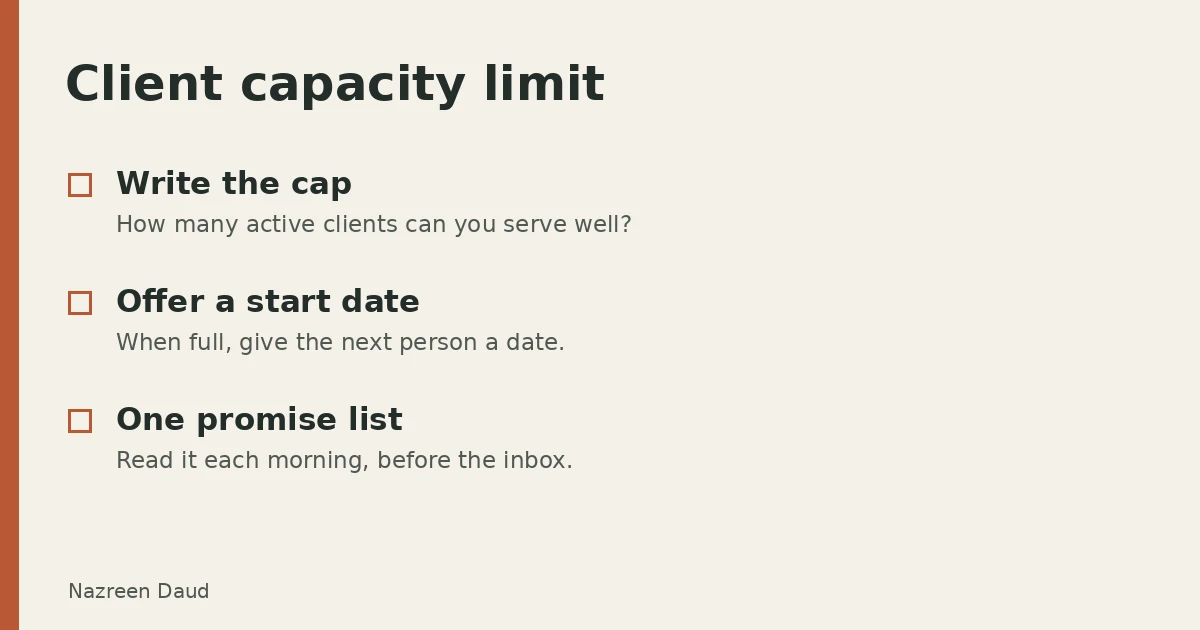
The short answer: a client capacity limit is the number of active clients you can serve well at one time, written down before the busy month arrives. When you're full, offer the next person a start date instead of squeezing them in. Then keep every small promise in one list you read each morning, before the inbox gets to you.
In this article
- Why does a busy month break small firms?
- What is a client capacity limit?
- Step 1: how do you write the number down?
- Step 2: what do you say when you're full?
- Step 3: how do you keep every promise in one list?
- Why does "yes, from the 14th" keep more clients?
- Is this the same as buying a CRM?
- Who is this not for?
- The client capacity checklist
- FAQ
Why does a busy month break small firms?
Because the work arrives faster than the habits that protect it. Sticky notes pile up, replies slip, and the small "I'll send it Friday" promises disappear into the noise. The month that was supposed to prove you had made it becomes the month that frays your reputation.
I read a post on Reddit from a small business owner who finally got the month they'd been hoping for. Then it nearly broke them. Sticky notes everywhere, replies missed, small promises slipping. The replies that stayed with me weren't about buying software. They were about deciding how many active clients you can serve well, offering a start date when you're full, and writing every promise down the moment you make it.
That's one person's story on a forum, not research. I've been building websites since 2012, and I've seen the same pattern in quieter form: the good month arrives, everyone says yes, and the calendar doesn't get a say until something has already slipped.
Think of a hawker stall with one wok. When the queue is long, the cook finishes what's on the stove, then takes the next order. Your client work needs the same honesty about what fits.
What is a client capacity limit?
A client capacity limit is a written number: how many active clients you can serve well at the same time. Not how many you'd like to bill. Not how many enquiries you got last week. How many you can still answer, deliver for, and keep promises to without nights and weekends becoming the default.
Pat Miller puts a useful picture around the same idea in How many clients can you actually take on?. His piece passes on a picture from one owner in his community: capacity as a hotel. Once every room is booked, the hotel is full. You stop taking reservations because there's nowhere left to put anyone. A hotel with no vacancy is just full, and people understand what that means. Your calendar is the same once you've counted your rooms.
Step 1: how do you write the number down?
Count the work, not the wish. Start with the hours you can reliably give to client delivery in a week, then subtract the hours that already belong to sales, admin, invoicing and the weeks that go sideways. Divide what's left by the hours one active client usually needs, including messages, meetings and revisions. Round down.
You don't need a fancy spreadsheet. A sticky note with "Active clients: max X" is enough to stop the next yes from being automatic. Review the number after a rough month. If promises slipped, the limit was the story, not your character.
A hypothetical example
This is a made-up illustration, not a real client. Say a solo coach has about 18 usable client hours a week after admin and buffer. If each client needs about three hours a week, the sustainable count is six, not ten. The point is writing a number before the next enquiry lands.
Step 2: what do you say when you're full?
Offer a start date. "I can begin with you on the 14th" sounds organised. Most people would rather wait a couple of weeks for someone who keeps their word than start tomorrow with someone who's already stretched.
The date in that sentence is an example, not a rule. Pick a real date you can keep. Write it in the reply before you hit send. If you need a deposit or a signed scope before that date is locked, say so in the same message. A verbal yes with no deposit is still not a booking, which is why I wrote why a verbal yes without a deposit isn't a yes.
A start date is kinder than a soft "maybe next month". The buyer knows where they stand, and you know which week is already sold.
Step 3: how do you keep every promise in one list?
Keep one list for every promise you make out loud. The "I'll send it Friday". The "let me check and come back to you". The "I'll revise that section after the call". Write it down the moment you say it, and read the list at the same time each morning, before the inbox gets to you.
The list is not a project plan. It is a short record of words you already gave someone. When a promise sits only in your head, a busy Tuesday will overwrite it. When it sits on one list you open before email, you get a chance to keep it.
This is close to the discipline of writing scope into a quote. Vague promises stretch the same way a vague price does. My S$3,000 lesson on scope in a quote is about the written edge of the work. The morning list is about the written edge of the day.
What belongs on the list
- Anything you said you would send, check, reply to or deliver by a named day.
- Follow-ups you promised after a call, even if they felt small.
- Open loops you created in a chat message while walking between meetings.
What doesn't belong: every task in the business. If the list grows into a second to-do system, you've stopped using it as a promise log. Keep it short enough to finish reading with a coffee.
If you'd like a second pair of eyes on how enquiries and start dates move through your week, book a call with me.
Why does "yes, from the 14th" keep more clients?
Because a clear wait usually feels safer than an unclear yes. I've learnt that saying "yes, from the 14th" loses far fewer clients than saying "yes" and then going quiet.
Silence after a quick yes is what damages trust. A dated start tells the buyer you run a calendar, not a scramble. The same honesty helps you spot a poor fit early: someone who insists on starting tomorrow no matter what may already be showing the client red flags in a first enquiry worth noticing.
A good month is one where you can still keep every promise you made in it. That line is the test. If the month was busy and every promise held, your client capacity limit is roughly right. If the month was busy and promises slipped, the limit was higher than the work could carry.
Is this the same as buying a CRM?
No. A client capacity limit is a decision about how many people you serve at once. A CRM is a tool for remembering who they are and what happens next. You can set a limit with a notebook. You can also outgrow a notebook and still need a limit.
If you're choosing software, my piece on CRM for a solo business covers the three jobs to test before you commit. Keep that article for the tooling question. This one stays on the ceiling, the start date and the promise list.
Who is this not for?
If you're still hunting for your first two or three clients, a hard cap is not the problem. Fill the calendar first, then write the limit when the yeses start to collide.
It also fits less well if your work is pure productised delivery with almost no custom follow-up. Even then, a written number helps you know when the next batch is due.
The client capacity checklist
Open your calendar and your last two weeks of messages. Tick these off.
- I have written down how many active clients I can serve well at one time.
- The number comes from hours I can actually give, not from a target revenue figure.
- When I'm at that number, my default reply offers a start date, not a squeezed yes.
- Every "I'll send it / check it / come back to you" goes on one list the moment I say it.
- I read that list at the same time each morning, before the inbox.
- A verbal yes still needs a deposit or signed scope before the start date is locked.
- I treat a quiet stretch as a chance to catch promises up, not as a reason to raise the cap overnight.
If you'd like me to walk through your own capacity number and start-date wording with you, book a call with me.
FAQ
What is a client capacity limit?
A client capacity limit is the number of active clients you can serve well at one time, written down in advance. It is based on the hours you can reliably give to delivery after admin and buffer, divided by the hours one client usually needs. Decide the number before the busy month forces the decision for you.
How do I tell a new client I'm full?
Offer a real start date in the same reply. "I can begin with you on the 14th" is clearer than a vague "maybe next month". Most buyers prefer a short wait with someone who keeps their word over an immediate yes from someone already stretched. Lock the date only once the deposit or signed scope is in place.
Do I need software to manage a client capacity limit?
No. The limit is a written number and a habit. A sticky note, a notebook or a simple list is enough to stop automatic yeses. Software can help you remember clients and reminders later, but it does not replace the decision about how many people you serve at once.
What should go on the daily promise list?
Only the things you already said you would do: sends, checks, replies and follow-ups with a named day. Write each one down the moment you say it, and read the list each morning before email. Keep it short. If it turns into a second full to-do system, it stops protecting the promises that matter most.
So, do you have a client capacity limit, or do you find out when things start slipping?
About the author: Nazreen Daud is Founder of Roquepress and a Malay web consultant and marketer in Singapore. He has built websites for businesses since he started freelancing in 2013, registered Roquepress in 2019 and founded Mulacan in 2022. He writes practical, hype-free notes on websites, SEO and AI for service businesses.