By Nazreen Daud, Malay web consultant and marketer in Singapore · Originally shared on LinkedIn, 28 August 2026
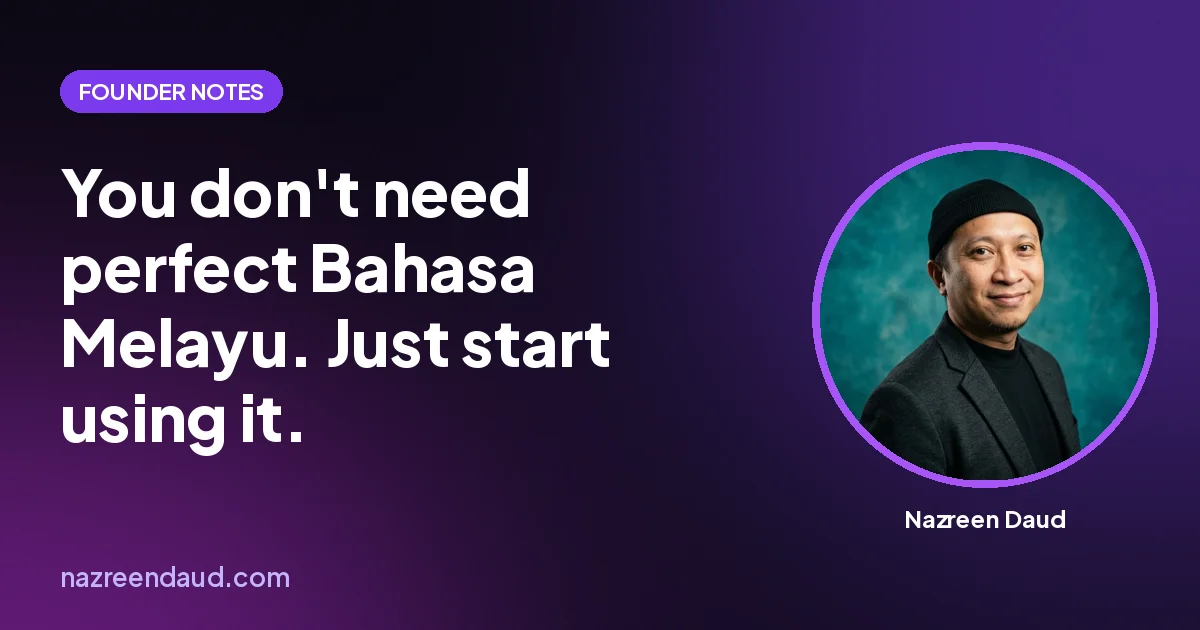
The short answer: the problem is not that we are bad at Bahasa Melayu. The problem is that we are afraid of sounding bad when we use it. You don't need to speak perfect Malay to be proud of it; you just need to start using it, especially at home, so our children grow up speaking it comfortably.
What happened at the Reclaiming Bahasa Melayu workshop?
In August, after our first day at The Business Show Asia 2026 at Marina Bay Sands with The Golden Nuggets Podcast, I attended Reclaiming Bahasa Melayu, a workshop organised by The Big Pivot.
Shout out to Khai Asyraf. It was an eye-opening workshop.
It wasn't just about reintroducing our mother tongue. It was about changing our mindset and rebuilding our confidence to use it.
Why do so many of us hesitate to speak Malay?
Day to day, many of us feel awkward or shy because:
- we struggle to find the right words,
- we can't articulate a certain context perfectly, or
- our sentences aren't grammatically flawless.
Think about it. When we use English, are we 100% fluent all the time?
Not exactly.
So why do we expect perfection from ourselves when speaking Bahasa Melayu?
That was one of the points shared by Mr Arif Tan, our linguistic professional at the session. (Loved your delivery, bro! Saya suka makan telur.)
Why does speaking Malay at home matter so much?
During the session, Abu Sofian and I agreed on something important: we need to pass this knowledge to our children.
If we keep avoiding Malay at home, our children may grow up unable to speak the language comfortably. And once confidence disappears, the language slowly disappears from everyday life too.
As a father of two boys, this one hits close to home for me.
How can we reclaim Bahasa Melayu day to day?
For me, reclaiming Bahasa Melayu begins with something simple:
| What to do | What it looks like in practice |
|---|---|
| Bring Malay back into the home | Use it in everyday family moments, not only on special occasions |
| Rebuild the connection between language and identity | Treat the language as part of who we are, not just a school subject |
| Speak naturally, not artificially | Use the Malay you have, mixed and imperfect, rather than waiting for perfect Malay |
| Appreciate the details of the language | Notice words, expressions and nuances, and enjoy them |
| Keep the language alive through daily conversations | Make it normal with friends, family and children |
A language doesn't survive only in classrooms, books or formal events.
It survives when families use it. When friends speak it. When children hear it. When we choose not to abandon it.
What does this have to do with my work?
I'm a Malay web consultant and marketer based in Singapore, and I run Roquepress, a Malay-owned marketing agency here. Language and identity show up in my work more than people might expect: in how a brand speaks to its community, in content written for Malay-speaking audiences, and in search, where people look for services in the language they think in.
The same lesson applies there as at home. Waiting for perfect is often the reason nothing gets said at all.
Want your business to speak clearly to your community, in English, Malay or both? Book a call with me.
The bottom line
You do not need to speak perfect Bahasa Melayu to be proud of it.
You just need to start using it.
FAQ
Why are people afraid to speak Bahasa Melayu? Many people worry about not finding the right words, not expressing an idea perfectly or making grammar mistakes. Yet we rarely expect perfect fluency from ourselves in English. Accepting imperfect Malay is the first step to using it more.
How can parents keep Malay alive at home? Use it in everyday conversations, not just formal occasions. Speak naturally, even if it's mixed with English, and let children hear it often. Confidence at home is what helps children grow up speaking the language comfortably.
What was the Reclaiming Bahasa Melayu workshop? It was a workshop organised by The Big Pivot that I attended in August 2026. It focused on changing mindsets and rebuilding confidence to use Bahasa Melayu day to day, rather than only reintroducing the language.
Next step
If you'd like help with a website or marketing that speaks to your community, book a call with me. Read more about me, see the tools I use, or explore my ventures.